Diagnostics Overview
This diagnostics package is part of the CADRE EPIC FV3-JEDI training workflow and is used in the 2026 CADRE Data Assimilation Workshop (https://epic.noaa.gov/cadre-epic-data-assimilation-training/). The tools support the hands-on sessions for the FV3-JEDI hybrid 3D-Var canned case (C96/C48), providing participants with a unified framework for analyzing background fields, increments, observation departures, spectral characteristics, and chi-squared consistency. The same diagnostics are used throughout the CADRE Year 2 experiments, including the ATMS, GNSSRO, ASCAT, and surface pressure components of the FV3-JEDI system.
The diagnostics toolkit provides a unified set of tools for analyzing background fields, increments, observation departures, and spectral properties of the data assimilation system. In addition to the standard diagnostic capabilities—increment maps, zonal means, observation histograms, satellite scan‑position bias checks, and latitude‑binned statistics—the toolkit includes two advanced diagnostic components:
Power Spectral Analysis Used to quantify how variance is distributed across spatial scales and how experiments (e.g., NICAS length‑scale changes) modify the spectral characteristics of increments and background fields.
Extended RMS Statistics Channel‑wise diagnostics of O–B and O–A bias, RMS, normalized RMS, bias‑corrected RMS, and analysis improvement metrics. These extended statistics provide a detailed view of observation‑space performance beyond simple mean and RMS values.
In addition, the toolkit supports a chi‑squared consistency check through automated parsing of JEDI log files. This diagnostic evaluates whether the ratio \(\mathrm{Jo}/p\) approaches unity, indicating consistency between the assumed observation‑error variances, the background errors, and the resulting analysis increments.
The toolkit also provides an innovation‑space error diagnostic based
on the Desroziers method. This diagnostic uses only the O–B and O–A
innovations to estimate the true observation‑error variance, assess the
adequacy of the specified R, and compute recommended variance‑scaling
factors for tuning observation errors in UFS DA workflows.
The following sections describe the mathematical formulation of these diagnostics and provide example figures illustrating their use.
Spectral Diagnostics
Overview
Spectral diagnostics quantify how variance is distributed across spatial scales. The UFS DA diagnostics compute isotropic 1‑D spectra derived from a full 2‑D horizontal Fourier transform. This reveals how the background (BKG), increments (INC), and experiment differences modify energy across scales.
2‑D Fourier Transform
For a horizontal field \(f(x, y)\) on an \(N_x \times N_y\) grid, the 2‑D Discrete Fourier Transform is
Each pair \((k_x, k_y)\) corresponds to one grid‑scale sinusoidal wave with a specific wavelength and direction.
Power Spectrum
The 2‑D power spectrum is
This represents the energy contribution of each grid‑scale wave.
Isotropic Spectrum
The 2‑D spectrum is radially averaged into bins of total wavenumber
to produce a 1‑D isotropic spectrum \(P(K)\). This gives the distribution of variance across spatial scales.
Parseval Consistency
The total variance in physical space equals the total power in spectral space:
This ensures that the isotropic spectrum is a true variance decomposition by scale.
Background vs Increment Spectra (Control Experiment)
The background (BKG) spectrum typically follows a smooth power‑law decay, reflecting the model’s natural distribution of variance. The increment (INC) spectrum is much smaller and shows how the analysis updates redistribute variance across scales.
A healthy DA system produces increments that:
contain most of their energy at large scales
have very little high‑wavenumber energy
do not inject noise at small scales
In the control experiment, the increment spectrum exhibits a large‑scale plateau. This is expected: the largest scales are dominated by broad, domain‑wide adjustments, and the isotropic bins at the smallest wavenumbers contain only a few modes, producing a flat appearance.
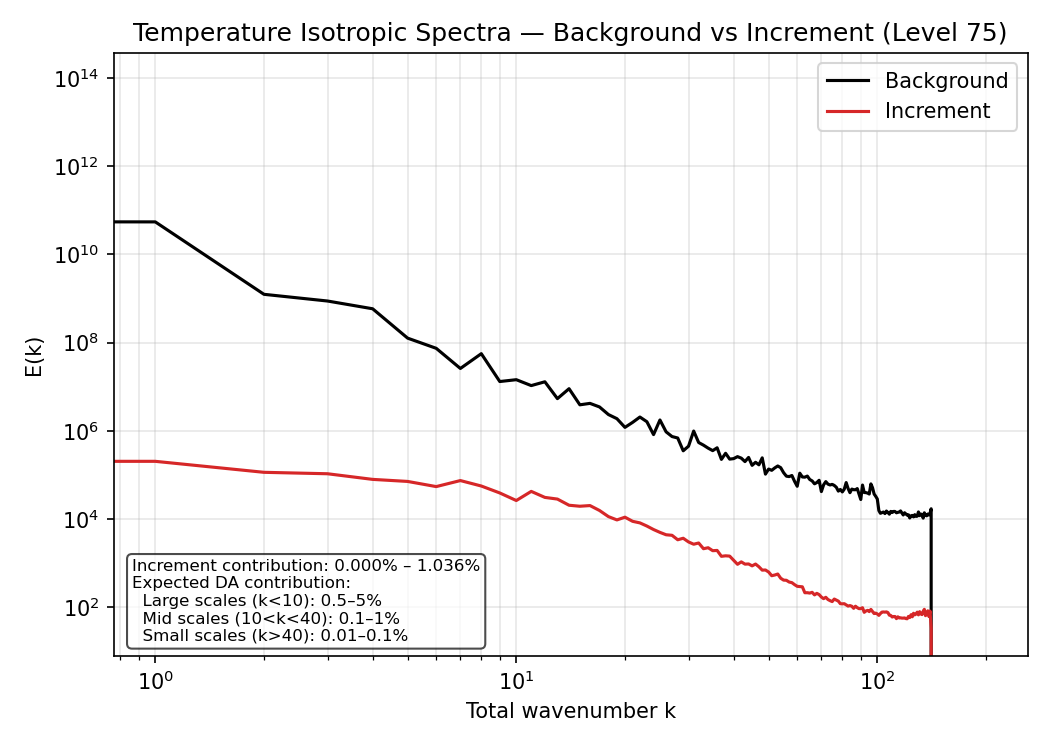
Background and increment spectra for temperature at model level 75 in the control experiment. The increment spectrum is smooth and confined to large scales. The plateau at the lowest wavenumbers reflects broad, domain‑scale adjustments and the small number of modes in the first isotropic bins.
Spectral Ratio (EXP vs CTRL)
The spectral ratio compares the scale‑dependent variance between two experiments:
Interpretation:
\(R(K) > 1\) — EXP has more energy in the grid‑scale waves at scale \(K\)
\(R(K) < 1\) — EXP has less energy at that scale
NICAS Length‑Scale Experiment
Increasing the NICAS horizontal correlation length scale broadens the static covariance’s spatial correlations. The static covariance itself is unchanged in shape; only the length scale parameter increases. This produces smoother increments and enhances variance at the largest spatial scales (small K), while reducing variance at smaller scales.
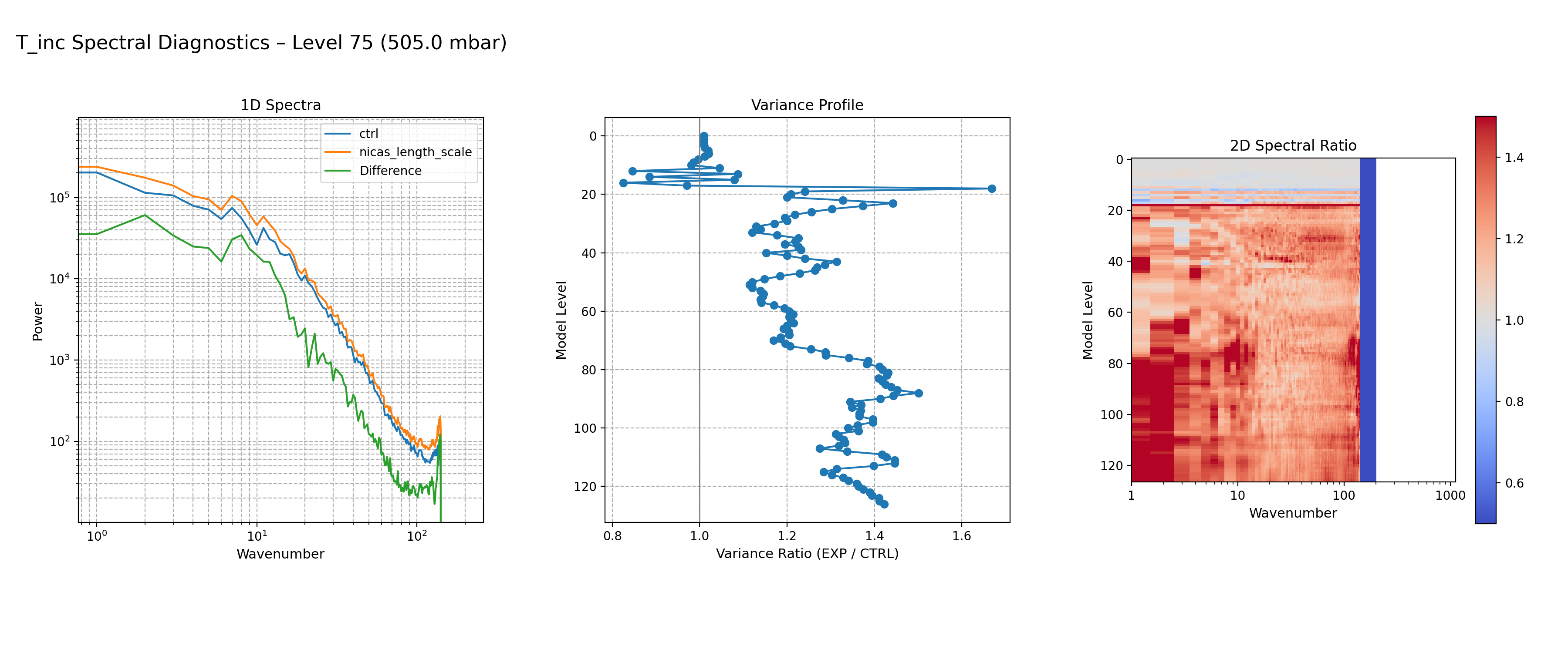
CTRL vs NICAS length‑scale increment spectra at model level 75. Increasing the NICAS horizontal correlation length scale boosts large‑scale variance and suppresses small‑scale variance, producing smoother increments.
Static Background Covariance Weight Experiment
This experiment increases the weight of the climatology‑based static background‑error covariance in the hybrid formulation. The static covariance itself is unchanged; only its relative contribution to the total hybrid covariance increases compared to the flow‑dependent ensemble covariance.
Increasing the static weight enhances variance at the largest spatial scales (small K) while suppressing variance at smaller scales. This produces smoother increments dominated by broad, domain‑scale structure.
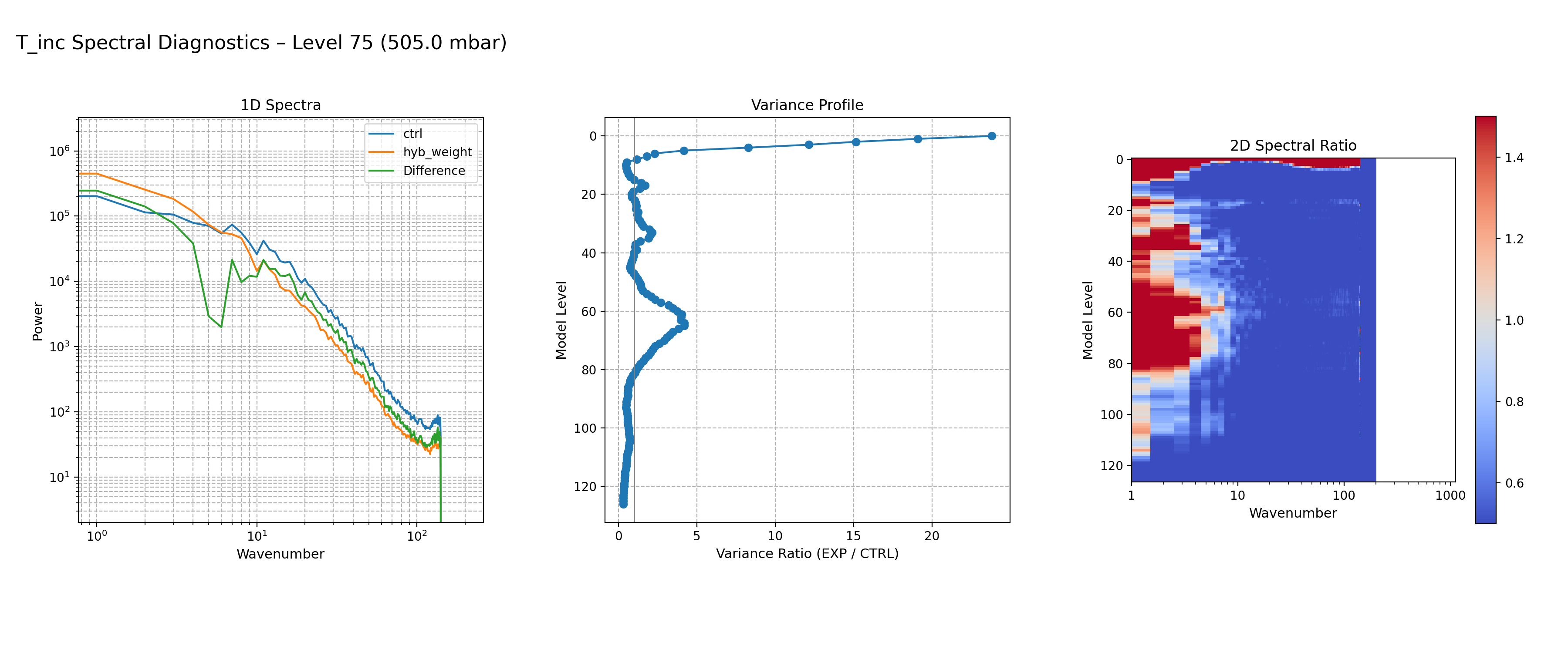
CTRL vs increased static background‑covariance weight for temperature increments at level 75. The increased static weight boosts large‑scale variance and damps small‑scale variance, reflecting the dominance of smoother climatological static covariance.
Observation Statistics
Formulation
Let \(y_i\) be an observation, and let \(H(x_b)_i\) and \(H(x_a)_i\) denote the background and analysis model equivalents. Define the departures:
Mean (Bias)
Meaning: Measures systematic error. A reduction from O–B to O–A indicates improved bias characteristics.
RMS (Root‑Mean‑Square Error)
Meaning: Measures total error magnitude (bias + random error).
RMS Difference (Analysis Improvement)
or normalized:
Meaning: Negative values indicate analysis improvement.
Normalized RMS
If observation error standard deviations \(\sigma_{o,i}\) are available:
Meaning: - \(\mathrm{RMS}_n \approx 1\) → observation errors well specified - \(\mathrm{RMS}_n \gg 1\) → errors underestimated - \(\mathrm{RMS}_n \ll 1\) → errors overestimated
Bias‑Corrected RMS
Meaning: Measures random error only (bias removed).
Extended ATMS Statistics
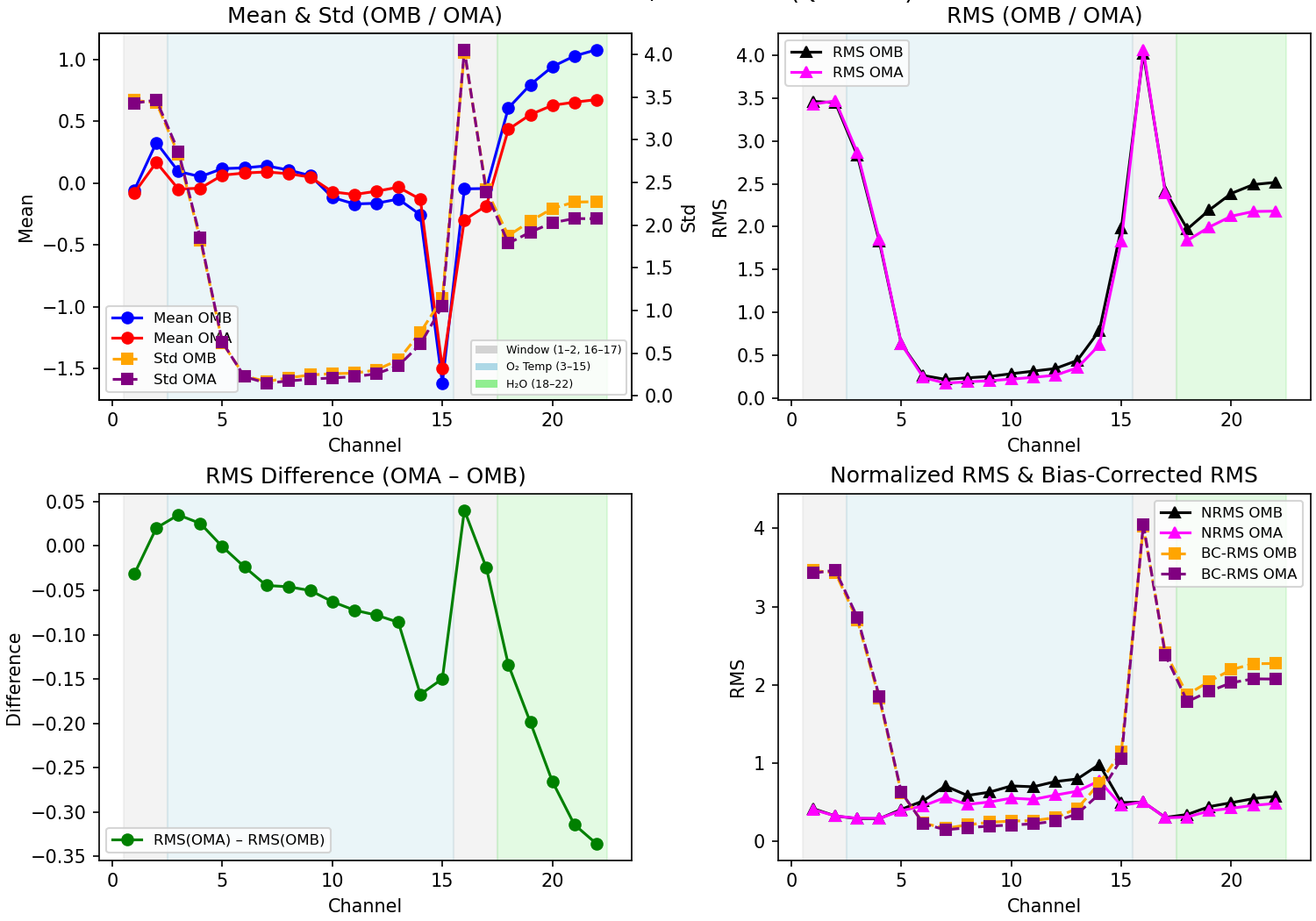
Extended ATMS observation‑space diagnostics showing O–B and O–A bias, RMS, normalized RMS, bias‑corrected RMS, and analysis improvement metrics. These statistics quantify systematic error, total error, random error, and the degree to which the analysis reduces observation‑space departures.
Chi‑Square Consistency Check
The chi‑square consistency diagnostic evaluates whether the innovations (OMB) are broadly compatible with the assumed observation‑error variances. It provides a quick indication of whether the specified observation‑error model is reasonable.
For each observation i, the innovation d_b is scaled by its assumed observation‑error variance σ_{o,i}². The normalized innovation is
If the observation‑error model is reasonable, the average value of z_i² should be close to one. This leads to the chi‑square consistency measure
Interpretation
χ² ≈ 1 → observation‑error variances are broadly consistent with the size of
the innovations.
χ² >> 1 → observation‑error variances are likely too small (innovations too
large).
χ² << 1 → observation‑error variances are likely too large (innovations too
small).
Practical Computation in JEDI
The toolkit computes this diagnostic by reading the JEDI log and using the reported values of Jo and the number of assimilated observations p:
Here Jo/p is a practical, heuristic average of the normalized innovation variance. It is not a formal statistical test, but it provides a quick sense of whether the assumed observation‑error variances are in a reasonable range.
Channel‑Wise Normalized RMS²
The obs_diagnostic.py (ufsda-obs-diag) script also computes a channel‑by‑channel normalized
RMS² value for instruments such as ATMS:
where N_c is the number of assimilated observations in channel c.
This quantity is directly comparable to Jo/p, but computed separately for each channel rather than over all observations. Channel‑wise NRMS² helps identify channels with mis-specified observation errors or representativeness issues.
Reference
Talagrand, O. (2003). Evaluation of probabilistic prediction systems. ECMWF Workshop on Diagnostics for Data Assimilation Systems.
Innovation-Space Error Diagnostics
The innovation-space error diagnostics module provides a lightweight implementation of the Desroziers et al. (2005) method for estimating observation-error variance and background-error contributions using only the innovations:
OMB = H(x_b) − y
OMA = H(x_a) − y
This diagnostic is implemented in
ufs_da_diagnostics/obs/innovation_br_check.py and is designed to
operate on the same YAML configuration and data structures used by the
standard obs_diag utilities.
The following quantities are computed for each channel or scalar observation type:
Sd = E[OMB^2]Innovation variance. Represents
HBH^T + R_true.R_est = E[OMA * OMB]Desroziers estimate of the true observation-error variance.
Sd/RInnovation chi-square proxy. Values < 1 indicate that the assumed
Ris too large; values > 1 indicate that the assumedRis too small.R_est/RRatio of estimated to assumed observation-error variance. This is the Desroziers variance scaling factor.
HBH^T = Sd - R_estBackground-error contribution to the innovation variance.
HBH^T/RBackground-to-observation ratio. Values below ~0.3 are typical for microwave radiances.
scale_R = R_est / RRecommended variance multiplier for tuning the assumed
R.infl_chi = sqrt((Sd/R) / chi_target)Standard-deviation inflation factor required to achieve a target chi-square (default
chi_target = 0.8).
Example output for a radiance channel:
Ch 09: Sd/R=0.158  R_est/R=0.114  HBH^T=0.018  HBH^T/R=0.044
       scale_R=0.114  infl_chi=0.445
Interpretation:
Sd/Rwell below 1 → assumedRis too large.R_est/Rconfirms the same.HBH^T/Rsmall → background contribution is modest.scale_Rsuggests reducing the assumed variance.infl_chisuggests reducing the standard deviation.
This diagnostic is intended for routine monitoring of observation-error consistency and for guiding observation-error tuning in UFS DA workflows.
Weather Events Diagnostics
The weather‑events module provides global synoptic‑scale diagnostics derived from FV3 ATM background fields. It identifies dynamically coherent features such as:
500 hPa cyclone centers (vorticity‑based)
250 hPa jet streaks (ridge detection)
850 hPa baroclinic zones (temperature‑gradient magnitude)
These diagnostics complement increment‑based tools by providing a large‑scale flow context for DA experiments.
See Weather Events Diagnostics for usage examples.